

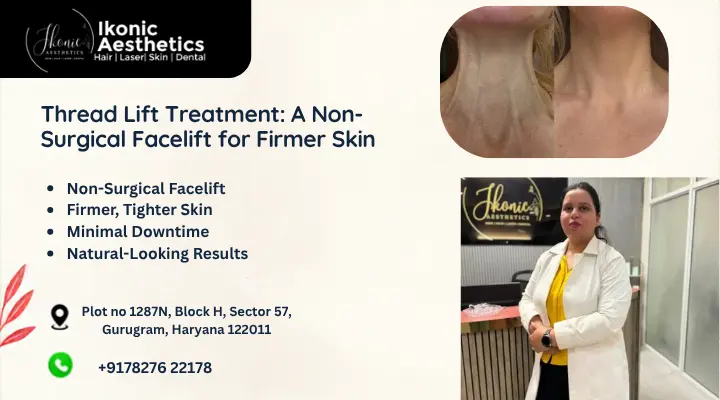
Skin naturally loses firmness and elasticity with age. Over time, reduced collagen production, changes in facial fat and the effects of gravity can contribute to sagging cheeks, deeper folds and loose skin around the jawline and neck. These changes are normal, but some people prefer treatments that help improve facial definition without undergoing a conventional facelift surgery.
Thread Lift Treatment: A Non-Surgical Facelift for Firmer Skin is an option for selected individuals seeking a subtle lifting effect with minimal incisions and a generally shorter recovery period than surgical facelifts. The procedure uses dissolvable medical threads placed beneath the skin to support targeted areas and stimulate the body’s collagen response.
Dr. Himani Yadav can be consulted to discuss facial aesthetic concerns, suitability for a thread lift and alternative treatment options. The best approach depends on skin quality, the degree of sagging, facial anatomy, medical history and the patient’s expectations.
This guide explains how thread lift treatment works, who may benefit, what the procedure involves and what to expect during recovery.
What Is Thread Lift Treatment? Signs, Causes and Diagnosis
Thread lift treatment is a minimally invasive cosmetic procedure designed to lift selected facial tissues and improve the appearance of mild to moderate skin laxity. Special medical threads are inserted beneath the skin using a fine needle or cannula. Depending on the thread design, the threads may provide mechanical support and stimulate collagen production as the body gradually absorbs them.
Unlike a surgical facelift, a thread lift does not involve removing excess skin. It generally offers a more subtle result and is not a replacement for surgery when significant skin laxity is present.
What Skin Concerns Can a Thread Lift Address?
People often consider Thread Lift Treatment when they notice early changes in facial firmness or definition.
Common concerns include:
- Mild sagging around the cheeks.
- Reduced definition along the jawline.
- Early jowls around the lower face.
- Mild skin laxity around the eyebrows.
- Fine lines and folds associated with changes in facial support.
- Mild sagging in selected areas of the neck, when appropriate for the technique.
- A less defined facial contour compared with previous years.
These are cosmetic concerns rather than symptoms of a medical disease. A thread lift may improve selected features, but it cannot eliminate every wrinkle, correct substantial excess skin or stop the ageing process.
What Causes Skin to Lose Firmness?
Several factors contribute to facial skin laxity.
Ageing and collagen loss: Collagen and elastin help maintain the skin’s structure. Their production and organisation change with age, reducing firmness and elasticity.
Sun exposure: Ultraviolet radiation can damage collagen and elastin, contributing to premature skin ageing.
Genetics: Inherited facial structure and skin characteristics influence how early sagging becomes noticeable.
Changes in facial volume: Changes in fat distribution and underlying tissue support can affect facial contours.
Weight fluctuations: Significant changes in body weight may influence facial fullness and skin appearance.
Lifestyle factors: Smoking, inadequate sun protection and other lifestyle factors can contribute to premature skin ageing.
Understanding the underlying cause is important because not every concern about facial ageing responds equally well to a thread lift.
How Is Suitability for a Thread Lift Diagnosed?
Before recommending Thread Lift Treatment: A Non-Surgical Facelift for Firmer Skin, a qualified medical professional should assess the patient’s facial structure, skin thickness, elasticity and degree of tissue laxity.
The consultation generally includes:
- A discussion of the patient’s concerns and desired results.
- An examination of the face and the areas requiring improvement.
- A review of medical history, allergies, previous cosmetic procedures and current medicines.
- An assessment of skin quality and whether a thread lift is likely to provide a meaningful improvement.
- A discussion of expected results, limitations, risks and alternative treatments.
People with significant skin laxity may benefit more from a surgical consultation or another treatment approach. Active skin infections, certain bleeding risks and other medical factors may make a thread lift unsuitable or require additional assessment.
How Does Thread Lift Treatment Work? Procedure and Benefits
A thread lift is usually performed as an outpatient procedure. The exact technique depends on the treatment area, the type of thread used and the clinician’s assessment.
What Happens During the Procedure?
The process typically involves the following steps.
1. Consultation and treatment planning
The clinician identifies the areas to be treated and discusses realistic outcomes. Photographs may be taken with the patient’s consent to document the initial appearance.
2. Preparation of the treatment area
The skin is cleaned, and local anaesthesia is commonly used to improve comfort during the procedure.
3. Thread placement
Using a fine needle or cannula, the clinician carefully inserts medical threads beneath the skin along planned paths. Some threads have small barbs or cones that help support the tissue, while others are designed primarily to stimulate collagen.
4. Positioning and adjustment
The threads are positioned to achieve the intended lifting effect. The clinician checks facial symmetry and makes appropriate adjustments.
5. Completion and aftercare instructions
The insertion points are checked, and the patient receives instructions on caring for the treated area, managing temporary discomfort and attending follow-up appointments.
The procedure often takes less time than a surgical facelift, although duration varies according to the number of threads and areas treated.
What Are the Benefits of a Thread Lift?
For appropriately selected patients, Thread Lift Treatment: A Non-Surgical Facelift for Firmer Skin may offer several benefits.
- Minimally invasive approach: The procedure generally uses small entry points rather than large surgical incisions.
- Subtle lifting effect: Selected facial areas may appear more supported and defined.
- Potential collagen stimulation: Certain dissolvable threads encourage a local tissue response associated with collagen production.
- Limited downtime: Recovery is generally shorter than after a surgical facelift.
- Outpatient treatment: Many procedures can be completed without an overnight hospital stay.
- Targeted treatment: Specific facial areas can be addressed according to individual needs.
Results vary, and the amount of improvement depends on the patient’s anatomy, skin quality, thread type and technique. A thread lift is not a permanent solution, and the effects usually diminish over time as the threads dissolve and ageing continues.
Who Is an Appropriate Candidate?
A thread lift may be suitable for adults who have mild to moderate facial skin laxity and want a modest improvement without undergoing a conventional facelift.
Potential candidates generally:
- Have realistic expectations about the degree of lifting possible.
- Prefer a minimally invasive procedure.
- Understand that results are temporary.
- Have no untreated infection in the intended treatment area.
- Are medically suitable after an individual assessment.
People with substantial excess skin, severe sagging or expectations of dramatic and long-lasting lifting may need another treatment. The decision should be made after a proper clinical consultation rather than based solely on age or photographs.
Thread Lift Treatment Cost: What Factors Matter?
The cost of Thread Lift Treatment depends on the individual’s treatment plan. It would be misleading to quote one fixed amount for every patient without knowing the clinical requirements.
Factors that may affect the cost include:
- The number and type of threads required.
- The facial areas being treated.
- The complexity of the procedure.
- The clinician’s expertise and treatment setting.
- Consultation and follow-up requirements.
- Any additional procedures recommended after assessment.
Patients should request a personalised estimate before proceeding and confirm what the quoted amount includes.
Recovery, Risks and Comparison With a Surgical Facelift
Recovery after a thread lift is generally shorter than recovery after a surgical facelift, but temporary swelling, bruising and tenderness are common. Following aftercare instructions is important for healing and for reducing the risk of complications.
What Is the Recovery Period After a Thread Lift?
Many people return to light daily activities within a few days, although the recovery period varies. Some swelling, bruising, tightness or mild discomfort may persist for one to two weeks. Temporary dimpling or unevenness can also occur as the tissues settle.
General aftercare may include:
- Avoiding unnecessary pressure, rubbing or massage of the treated areas.
- Following the clinician’s advice on sleeping position.
- Avoiding strenuous exercise for the recommended period.
- Limiting excessive facial movements if instructed.
- Following guidance about dental procedures and other activities that may place pressure on the face.
- Keeping follow-up appointments to assess healing.
Patients should not attempt to reposition threads or massage irregular areas without medical advice.
Increasing pain, spreading redness, fever, discharge, visible thread exposure, significant asymmetry or changes in skin colour require prompt assessment. Vision changes or severe, sudden symptoms warrant urgent medical attention.
What Are the Risks of Thread Lift Treatment?
Although minimally invasive, thread lift procedures carry risks. Possible complications include:
- Bruising, swelling and tenderness.
- Infection at an insertion site.
- Temporary dimpling or skin irregularity.
- Asymmetry or an unsatisfactory cosmetic result.
- Threads becoming visible or palpable beneath the skin.
- Thread migration or extrusion.
- Rare injury to nearby structures or persistent discomfort.
The risk profile depends on the technique, the treatment area, the clinician’s experience and the patient’s health. Patients should discuss potential complications and the plan for managing them before giving consent.
Thread Lift vs Surgical Facelift
| Feature | Thread lift | Surgical facelift |
| Approach | Minimally invasive thread placement | Surgery involving incisions and tissue repositioning |
| Best suited for | Selected cases of mild to moderate laxity | Often more suitable for substantial sagging |
| Anaesthesia | Commonly local anaesthesia | Depends on the surgical technique |
| Recovery | Generally shorter | Generally longer |
| Results | Usually subtle and temporary | Typically more substantial and longer-lasting |
| Excess skin removal | No | May be included |
| Risks | Includes dimpling, infection and thread-related problems | Includes surgical, anaesthetic and wound-healing risks |
Neither treatment is universally better. The appropriate choice depends on the degree of facial ageing, medical suitability, desired results and willingness to undergo surgery and recovery.
How Long Do Thread Lift Results Last?
The duration varies according to the thread material, technique, treatment area and individual response. Many patients experience results lasting several months to around one year, sometimes longer, but this cannot be guaranteed.
The threads gradually dissolve, while collagen-related changes may continue to influence the skin. However, collagen stimulation does not make the result permanent. A clinician can explain the expected duration for the specific thread system being considered.
Frequently Asked Questions About Thread Lift Treatment
1. What is Thread Lift Treatment?
Thread Lift Treatment is a minimally invasive cosmetic procedure that uses medical threads placed beneath the skin to support selected facial tissues and, with certain thread types, stimulate collagen production.
2. Is a thread lift a non-surgical facelift?
Yes. It is commonly described as a Non-Surgical Facelift because it can provide a modest lifting effect without conventional facelift surgery. However, it does not remove excess skin or deliver the same results as a surgical facelift.
3. Is thread lift treatment painful?
Local anaesthesia is commonly used to reduce discomfort. Patients may experience pressure during the procedure and soreness, tightness or tenderness afterwards. Individual experiences vary.
4. How long does the procedure take?
The procedure may take approximately 30–60 minutes in many cases, although more complex treatments can take longer. The actual duration depends on the number of threads and areas being treated.
5. How soon can I return to work?
Some patients return to light activities within a day or a few days. Bruising, swelling and tenderness may remain visible for one to two weeks, so recovery should be planned around individual needs and the clinician’s advice.
6. Is thread lift treatment safe?
It can be performed safely in appropriately selected patients by a qualified and experienced medical professional, but it is not risk-free. Infection, dimpling, asymmetry, thread exposure and other complications are possible.
7. Can a thread lift remove deep wrinkles?
A thread lift primarily targets selected areas of tissue support and mild to moderate laxity. It may improve some facial folds indirectly, but it is not designed to eliminate deep wrinkles or treat every sign of aging.
8. Can thread lift treatment be combined with other cosmetic procedures?
In selected cases, a thread lift may be combined with other treatments. The timing and suitability depend on the procedures involved, the patient’s medical history and the risk of complications. A clinician should determine the treatment sequence.
9. Who should avoid a thread lift?
People with active infections in the treatment area, certain bleeding disorders, unsuitable skin or tissue conditions, or other relevant medical risks may need to avoid or postpone the procedure. An individual medical assessment is necessary.
10. Where can I enquire about thread lift treatment in Gurugram?
You can contact Dr. Himani Yadav regarding consultation and treatment suitability at the following location.
Address: Plot No. 1287N, Block H, Sector 57, Gurugram, Haryana 122011.
Confirm the available services and appointment details directly before visiting.
Conclusion: Explore Thread Lift Treatment for Firmer-Looking Skin
Thread lifts can provide a minimally invasive option for adults who want to improve mild to moderate facial sagging without undergoing a conventional facelift. By supporting selected tissues and potentially stimulating collagen production, the procedure may improve facial definition with a relatively short recovery period.
However, results are temporary, and the procedure cannot replace surgery for significant excess skin. Understanding the benefits, limitations, recovery requirements and possible complications is essential before making a decision.
Thread Lift Treatment: A Non-Surgical Facelift for Firmer Skin should begin with a personalized consultation to determine whether the procedure matches your facial anatomy and aesthetic goals. Dr. Himani Yadav can discuss your concerns, assess treatment suitability and explain the options available for achieving a natural-looking result.
Book your consultation with Dr. Himani Yadav to discuss thread lift treatment in Gurugram.
- Doctor: Dr. Himani Yadav
- Location: Plot No. 1287N, Block H, Sector 57, Gurugram, Haryana 122011
- Contact: +917827622178